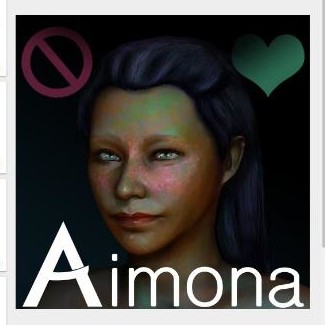
Ultimately, the entire museum/gallery experience will be curated by Aimona such that for any individual who enters the museum/gallery, each screen will recognize them and their preferences. They will be greeted with works selected for them, by their determined preferences based on Aimona’s ‘careful’, ongoing machine learning algorithms. Each person would see something different (or not, but no one would know), something uniquely attuned to their taste.
But then what would this mean? It has been demonstrated that we ‘like’ what we see frequently. That we prefer what we are familiar with. If we only ever see what aligns with our original self-determined preferences, will there ever be any evolution? Will we wish to create? Will we all see the same thing — or will we even question whether what another person sees might be of interest to us since our AI overlord knows us so deeply and has determined that to be a waste of time, would we ever be able to or even want to see something else, something other too? Will Aimona replace culture? Will Aimona culture replace meaning?
=== SPOILER === materials & process === SPOILER ===
Phase one is this free-to-play mobile, dynamic educational app distributed through Google Play and iOS App Store: an application modeled after the Tindr dating app (aka same user addictive interface that feeds you endless visuals to consider for an instant before swiping left or right to indicate you like or dislike it) to gather a corpus of data regarding human preferences in fine arts utilizing the open domain works of the Metropolitan Museum of Art. The data will feed an open source machine learning algorithm, currently used to predict user preferences in film and comics, to then allow Aimona to provide participants with recommendations of Art to be viewed.
I have completed the design and development of this app, Aimona, developed the backend (hosted here) to collect the data, and successfully deployed it to both iOS and Google Play with some 500 downloads in the first two months.
My concept for the second phase of this dystopian warning involves locked rooms, AR private projections, and isolation.
(update from 8 years in the future: I was disturbingly on to something here)